
Ellenton · Manatee County
Garbage Disposal Installation and Replacement in Ellenton, FL
A disposal that hums without turning, leaks from underneath or simply quit after years of use is a common kitchen call. TK Plumbing installs and replaces garbage disposals throughout Ellenton, and we take into account whether your home drains to county sewer or a septic tank before suggesting a model.
Septic homes need a different conversation
Some Ellenton properties, particularly older lots and homes away from the main roads, still drain to a septic tank. A disposal sends ground food solids into that tank, and those solids add to the sludge layer that has to be pumped out. That does not mean a septic home cannot have one, but it changes the choice.
Models made for septic use add enzymes or are designed to grind finer, and using the disposal lightly, with food scraps going to the trash or a compost bin first, keeps the tank healthier. If you have septic, expect to have it pumped somewhat more often once a disposal is in regular use. Homes on county sewer have fewer limits, but the drain line still has to carry everything you grind.
Repair or replace?
A disposal that hums but does not spin is usually jammed. With the power off at the switch and the breaker, an Allen wrench in the socket on the bottom of the unit can work the grinding plate free, and the red reset button on the base restores it after an overload.
Leaks are a different story. Water dripping from the bottom of the housing means the internal seals have failed, and that cannot be repaired economically. Leaks from the sink flange or the dishwasher connection, on the other hand, can usually be fixed by resealing. Units that sit unused for months while their owners are away for the season sometimes seize with rust; if freeing the plate does not work, a replacement is the practical answer.
Choosing a unit
- Motor size: smaller units suit light use, while larger households and frequent cooks benefit from more power and less jamming
- Continuous feed versus batch feed: batch feed runs only with the cover in place, which some households prefer for safety
- Grinding stages and sound insulation: quieter units are worth it in open kitchens
- Corded or hardwired: we match the electrical setup already under the sink or recommend changes
- Septic-rated options for homes not on sewer
What installation involves
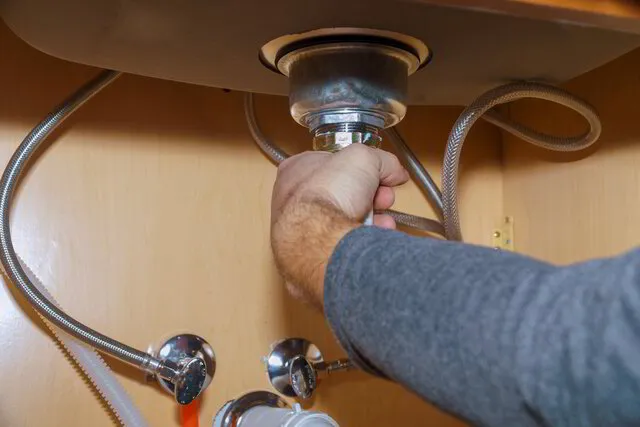
We remove the old unit, clean and reseal the sink flange with fresh plumber's putty, mount the new disposal, and reconnect the drain and the dishwasher hose. On a new install with a dishwasher, the knockout plug inside the disposal's dishwasher inlet must be removed, a small step that, when missed, leaves the dishwasher unable to drain.
We also look at the trap and drain arm. In older Ellenton kitchens the drain can sit too high or too low for a disposal outlet, and a poorly pitched trap holds food waste. Adjusting it during installation prevents clogs later. Everything is run with water before we leave so you can see there are no drips.
Keeping it working
Run cold water before, during and for a few seconds after grinding. Avoid fibrous peels, corn husks, large bones, coffee grounds in quantity and any grease. Grinding a few ice cubes now and then helps clean the chamber. If you leave for the summer, run the disposal briefly with water before you go and again on your return.
TK Plumbing is licensed in Florida (CFC1426077). Call 941-392-3846 to schedule a disposal install.
Ellenton questions
Can I have a garbage disposal if my Ellenton home is on septic?
Yes, with care. A septic-rated model and light use help, and you should plan on more frequent tank pumping. We can talk through whether it makes sense for your system.
My dishwasher stopped draining after a new disposal went in. What happened?
The plug inside the disposal's dishwasher inlet was most likely left in place. It has to be knocked out before the dishwasher hose is connected.
Why does my disposal smell even when it runs fine?
Food residue collects under the splash guard and in the grinding chamber. Cleaning the guard and grinding ice with a little dish soap usually helps; persistent odor can mean a poorly draining trap below.