
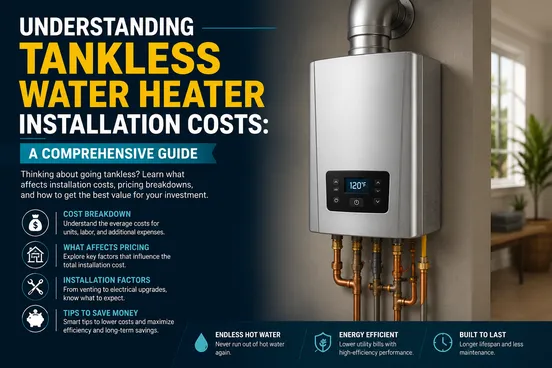
Understanding Tankless Water Heater Installation Costs: A Comprehensive Guide
When it comes to upgrading your home or commercial property's hot water system, tankless water heaters [cite: 2] have emerged as a popular choice for property owners seeking energy efficiency and long-term savings. However, understanding the true tankless water heater installation cost can be complex, involving multiple factors that extend beyond the initial purchase price. Whether you're a homeowner looking to reduce utility bills, a property manager overseeing multiple units, or a business owner seeking reliable hot water solutions, making an informed decision requires comprehensive knowledge of installation expenses, ongoing benefits, and long-term value propositions. This guide will walk you through every aspect of tankless water heater costs, from initial equipment selection to professional installation requirements, helping you make the best choice for your specific needs and budget constraints while maximizing your investment in modern plumbing technology.
Introduction to Tankless Water Heaters
Tankless water heaters, also known as on-demand or instantaneous water heaters, represent a revolutionary approach to hot water production that eliminates the need for traditional storage tanks. Unlike conventional systems that continuously heat and store large volumes of water, tankless units heat water directly as it flows through the device, providing hot water only when needed. This innovative technology utilizes powerful heating elements or gas burners that activate when a hot water tap is opened, delivering an endless supply of heated water at consistent temperatures.
The tankless water heater benefits over traditional storage systems are substantial and multifaceted. Energy efficiency stands as the primary advantage, with tankless units typically consuming 24-34% less energy than conventional water heaters [cite: 2] in homes using 41 gallons or less of hot water daily. Space savings represent another significant benefit, as these compact units mount on walls and free up valuable floor space previously occupied by bulky storage tanks. Additionally, tankless systems offer longer lifespans, typically lasting 20+ years compared to traditional heaters' 10-15 year expectancy, while providing unlimited hot water supply without the risk of running out during peak usage periods.
Tankless water heaters prove ideal for various settings and applications. Residential properties benefit from their space-saving design and energy efficiency, particularly smaller homes, condominiums, and apartments where space is premium. Commercial establishments like restaurants, offices, and retail businesses appreciate the consistent hot water supply and reduced operational costs. Properties with limited utility room space, vacation homes, and new construction projects find tankless systems particularly advantageous due to their flexible installation options and modern efficiency standards.
Understanding Installation Costs
The tankless water heater installation cost varies significantly based on multiple interconnected factors that property owners must carefully consider when budgeting for this upgrade. Understanding these cost variables helps ensure accurate financial planning and prevents unexpected expenses during the installation process. Professional installation typically represents a substantial portion of the total project cost, making it essential to understand all contributing elements before making your final decision.
Several critical factors influence the overall installation expense. The type of fuel source significantly impacts costs, with gas units requiring proper venting systems and potential gas line modifications, while electric units may necessitate electrical panel upgrades and dedicated circuits. Existing infrastructure plays a crucial role, as homes with compatible gas lines, adequate electrical capacity, and proper venting systems typically incur lower installation costs. Conversely, properties requiring extensive modifications to accommodate tankless systems face substantially higher expenses. Geographic location affects both equipment and labor costs, with urban areas generally commanding higher prices than rural locations. The complexity of installation, including accessibility of installation areas, required permits, and local building codes, further influences total project costs.
Typical price ranges for tankless water heater installation vary considerably based on system type and installation complexity. Electric tankless units generally range from $1,500 to $4,500 installed, including equipment and labor costs. Gas tankless systems typically cost between $2,500 and $6,500 installed, with premium high-efficiency models reaching $8,000 or more. These ranges encompass standard installations in homes with compatible existing infrastructure. Properties requiring significant modifications, such as gas line extensions, electrical panel upgrades, or complex venting systems, may experience costs exceeding these typical ranges by $1,000 to $3,000 or more.
When comparing electric versus gas tankless water heaters, several cost considerations emerge. Electric units typically feature lower upfront equipment costs, ranging from $800 to $2,500, but may require expensive electrical upgrades if existing service panels lack adequate capacity. Gas units generally cost more initially, from $1,200 to $4,000, but often provide lower operating costs in areas with favorable natural gas rates. Installation complexity differs significantly, with gas units requiring professional venting and gas line work, while electric units may need substantial electrical modifications. Long-term operating costs favor gas units in most regions, though this varies based on local utility rates and usage patterns.
Key Factors Affecting Tankless Water Heater Installation Cost
The type of unit and brand preferences significantly impact the overall tankless water heater installation cost, with options ranging from basic residential models to premium commercial-grade systems. Entry-level electric units from reputable manufacturers typically start around $800-$1,200, while high-end gas models from premium brands can exceed $4,000. Brand reputation affects both initial cost and long-term reliability, with established manufacturers like Rinnai, Navien, and Rheem commanding higher prices but offering superior warranties and performance. Unit capacity, measured in gallons per minute (GPM), directly correlates with cost, as higher-capacity units required for large homes or commercial applications cost substantially more than smaller residential models. Energy efficiency ratings also influence pricing, with ENERGY STAR certified units typically costing 15-30% more than standard models but providing greater long-term savings.
Labor costs vary dramatically across different regions, creating significant disparities in total installation expenses. Metropolitan areas typically command higher hourly rates, with skilled plumbers charging $75-$150 per hour compared to $50-$100 in smaller cities and rural areas. Regional building codes and permit requirements further influence costs, as some jurisdictions mandate additional safety features or inspection procedures. Seasonal demand fluctuations affect pricing, with peak installation periods during fall and early winter often resulting in premium pricing. The availability of qualified technicians in specific areas also impacts costs, as regions with limited certified installers may experience higher rates due to reduced competition.
Permits and additional plumbing requirements represent often-overlooked cost factors that can substantially increase project expenses. Most jurisdictions require permits for tankless water heater installations, with fees ranging from $50 to $300 depending on local regulations. Gas installations typically require additional permits and inspections, potentially adding $200-$500 to total costs. Existing plumbing modifications frequently become necessary, particularly in older homes where current systems may not meet modern codes. These modifications can include upgrading gas lines from 1/2-inch to 3/4-inch diameter, installing new electrical circuits, adding proper venting systems, or relocating water lines to accommodate the new unit's position. Such modifications can add $500-$2,500 to the base installation cost, depending on complexity and local labor rates.
Cost Breakdown for Tankless Water Heater Installation
Equipment costs represent the foundation of any tankless water heater project, with unit prices varying based on capacity, efficiency ratings, and manufacturer specifications. Basic electric tankless units suitable for small apartments or single-bathroom homes typically range from $800-$1,500, while mid-range residential models capable of serving 2-3 bathrooms cost $1,200-$2,500. High-capacity gas units designed for large homes or light commercial applications range from $2,000-$4,500, with premium condensing models reaching $5,000 or more. Additional equipment requirements include mounting hardware, typically costing $50-$150, and safety accessories such as pressure relief valves, isolation valves, and water filters, adding another $100-$300 to equipment costs. For gas installations, venting materials including stainless steel vent pipes, termination caps, and support brackets can add $200-$800 depending on installation complexity and vent run length.
Labor costs constitute a significant portion of the total tankless water heater installation cost, reflecting the specialized skills required for proper installation. Standard installations in homes with compatible existing infrastructure typically require 4-8 hours of professional labor, costing $400-$1,200 at prevailing regional rates. Complex installations involving gas line modifications, electrical upgrades, or extensive venting work may require 8-16 hours, resulting in labor costs of $800-$2,400. Specialized tasks such as electrical panel upgrades require licensed electricians charging $100-$200 per hour, potentially adding $500-$1,500 for major electrical modifications. Gas line work performed by licensed gas technicians adds similar costs, particularly when extending lines or upgrading to larger diameter pipes. Emergency or weekend installations typically command 25-50% premium pricing, making scheduling flexibility important for cost-conscious property owners.
Additional costs beyond equipment and basic labor can significantly impact total project expenses. Building permits typically range from $50-$300, with some jurisdictions requiring separate permits for electrical and gas work. Inspection fees add another $75-$200, depending on local requirements and the number of required inspections. Structural modifications such as wall reinforcement for heavy units, creation of new utility connections, or installation of dedicated electrical circuits can add $300-$1,500. Water treatment equipment, often recommended or required in areas with hard water, adds $200-$800 for basic filtration systems. Disposal fees for old water heaters typically range from $50-$150, though some contractors include this service in base pricing. Finally, warranty extensions and service agreements, while optional, provide valuable protection and typically cost $200-$500 annually.
Estimating Total Costs: A Case Study
For a small home installation, consider a typical 1,200 square-foot residence with two bathrooms and moderate hot water usage patterns. This scenario involves replacing a traditional 40-gallon electric water heater with a whole-house electric tankless unit capable of delivering 6-8 GPM. The equipment selection includes a mid-range electric tankless unit costing approximately $1,800, featuring digital temperature controls and energy-efficient operation. Installation requirements include mounting the unit in the existing water heater location, connecting to existing plumbing lines, and upgrading the electrical service to accommodate the unit's 28-32 kW power requirements. The electrical upgrade necessitates installing a new 150-amp breaker and dedicated 220V circuit, adding $800 in electrical work. Labor for plumbing connections and system commissioning requires approximately 6 hours at $100 per hour, totaling $600. Additional costs include permits ($150), disposal of the old unit ($75), and miscellaneous materials ($200). The total project cost reaches approximately $3,625, representing a typical small home installation with moderate complexity. This investment provides immediate benefits including unlimited hot water supply, 30% reduction in water heating costs, and valuable floor space recovery.
Commercial setting installations present different cost structures and requirements, as demonstrated by a small restaurant requiring consistent hot water for kitchen operations and customer facilities. This scenario involves installing a high-capacity gas tankless system capable of delivering 12-15 GPM continuously during peak operations. Equipment selection includes a commercial-grade condensing gas unit costing $4,200, designed for heavy-duty applications and featuring advanced controls. Installation complexity increases due to commercial building codes [cite: 2] requiring enhanced venting systems, gas line upgrades from 1-inch to 1.25-inch diameter, and specialized mounting requirements. Gas line modifications cost approximately $1,200, while the stainless steel venting system adds $900. Professional installation requires 10 hours of specialized labor at $125 per hour, totaling $1,250. Commercial permits and inspections cost $400, and additional safety equipment adds $300. The total project cost reaches $8,250, reflecting the enhanced requirements and capabilities of commercial applications. This investment provides substantial operational benefits including reduced energy costs, eliminated storage tank maintenance, and improved space utilization in valuable commercial real estate.
Cost differences based on average usage patterns significantly impact both installation decisions and long-term value propositions. Low-usage households consuming 20-30 gallons daily benefit most from compact electric units, minimizing both installation costs and operational complexity. These installations typically cost $2,000-$3,500 and provide 20-30% energy savings compared to traditional systems. Medium-usage properties consuming 40-60 gallons daily often justify higher-capacity gas units despite increased installation costs, as operational savings offset the premium investment within 5-7 years. High-usage applications consuming 80+ gallons daily, common in large families or commercial settings, require premium systems costing $5,000-$8,000 installed but provide substantial long-term savings and operational benefits that justify the investment through reduced energy costs and improved reliability.
Financing Options and Incentives
Available financing plans for homeowners have made tankless water heater installations more accessible, with multiple options accommodating different financial situations and preferences. Many plumbing contractors, including established companies like TK PLUMBING, offer in-house financing programs featuring competitive rates and flexible terms. These programs typically provide 12-60 month payment plans with interest rates ranging from 0% promotional financing to 12% APR, depending on creditworthiness and promotional periods. Home improvement loans from banks and credit unions offer another financing avenue, with secured loans against home equity providing the lowest rates, typically 3-7% APR for qualified borrowers. Unsecured personal loans, while carrying higher rates of 6-15% APR, offer quick approval and funding without collateral requirements.
Government incentives and rebates for energy-efficient appliances provide substantial cost offsets for qualifying tankless water heater installations. Federal tax credits through the Inflation Reduction Act offer up to $2,000 for ENERGY STAR certified tankless units, significantly reducing net installation costs. State-level incentives vary by location, with programs in energy-conscious states like California, New York, and Massachusetts offering additional rebates of $300-$1,500. Local utility companies frequently provide rebates for energy-efficient upgrades, with amounts ranging from $200-$800 depending on unit efficiency ratings and local program funding. These incentives often combine, potentially reducing total project costs by $500-$3,000 for qualifying installations.
Long-term savings analysis demonstrates the compelling financial benefits of tankless water heater investments despite higher upfront costs. Energy efficiency improvements typically reduce water heating costs by 24-34% annually, translating to $200-$500 yearly savings for average households. Extended equipment lifespans of 20+ years compared to traditional heaters' 10-15 year expectancy provide additional value through reduced replacement frequency. Maintenance cost reductions, stemming from tankless units' simpler design and lack of storage tank issues, save approximately $100-$300 annually. Property value improvements from modern, energy-efficient systems add $1,000-$3,000 to home values. Combined benefits typically provide full cost recovery within 6-10 years, followed by decades of continued savings and improved performance.
Choosing the Right Plumbing Service for Installation
Selecting a qualified plumbing contractor represents a critical decision that significantly impacts installation quality, cost, and long-term system performance. Professional expertise ensures proper sizing, installation, and commissioning, preventing costly mistakes and safety hazards. When evaluating potential contractors, verify proper licensing and insurance coverage, as tankless installations require specialized knowledge and certification. Look for contractors with specific tankless water heater experience, demonstrated through manufacturer certifications and completed project portfolios. Established companies with local presence provide better warranty support and ongoing service availability.
The importance of reviews and testimonials cannot be overstated when selecting installation professionals. Online platforms like Google, Yelp, and Better Business Bureau provide valuable insights into contractor reliability, quality, and customer service. Pay particular attention to reviews mentioning tankless installations, noting comments about project completion times, cleanup quality, and post-installation support. Professional references from recent customers offer deeper insights into contractor performance and reliability. Manufacturer partnerships and certifications indicate ongoing training and technical competency, ensuring installers remain current with evolving technology and installation best practices.
Essential questions to ask before hiring include inquiries about licensing, insurance, and manufacturer certifications. Request detailed written estimates including equipment specifications, labor costs, and project timelines. Clarify warranty coverage for both equipment and installation work, ensuring comprehensive protection. Discuss potential complications and additional costs, seeking transparency about possible scenarios requiring extra work. Inquire about maintenance requirements and ongoing service availability, as tankless systems benefit from annual professional servicing. Verify permit handling and inspection coordination, ensuring full compliance with local codes and regulations.
Maintenance and Aftercare
Routine maintenance tips for tankless water heaters ensure optimal performance and maximum lifespan while protecting your installation investment. Annual professional maintenance should include descaling to remove mineral buildup, particularly important in areas with hard water where calcium and magnesium deposits can reduce efficiency and damage heating elements. DIY maintenance tasks include monthly visual inspections of venting systems for gas units, checking for proper exhaust flow and clearance from obstructions. Water filter replacement, typically required every 3-6 months depending on water quality[cite: 2], prevents sediment damage and maintains optimal flow rates. Flushing the system annually helps remove accumulated debris and maintains proper operation.
Signs of potential issues to watch for include fluctuating water temperatures, reduced flow rates, unusual noises during operation, and error codes displayed on digital units. Temperature inconsistencies often indicate scaling issues or failing heating elements requiring professional attention. Flow rate reductions may signal clogged filters, mineral buildup, or plumbing restrictions. Strange noises, particularly with gas units, can indicate venting problems or combustion issues requiring immediate professional evaluation. Error codes provide diagnostic information helping technicians quickly identify and resolve problems. Prompt attention to these warning signs prevents minor issues from becoming major repairs.
How maintenance impacts long-term costs demonstrates the value of proactive care for tankless water heater systems. Regular maintenance typically costs $150-$300 annually but prevents expensive repairs and premature replacement. Neglected systems may require component replacement costing $500-$1,500 or complete unit replacement within 10-12 years instead of the expected 20+ year lifespan. Proper maintenance maintains energy efficiency, preventing the 10-20% efficiency degradation common in poorly maintained units. Warranty protection often requires documented maintenance, making professional service essential for coverage validation. Well-maintained systems provide consistent performance and reliability, avoiding inconvenient breakdowns and emergency repair costs.
Conclusion and Final Recommendations
Understanding tankless water heater installation costs requires comprehensive evaluation of equipment, labor, and additional expenses that collectively determine your total investment. Throughout this guide, we've explored how various factors influence pricing, from unit selection and capacity requirements to regional labor costs and permit requirements. The key takeaway is that while tankless systems require higher upfront investment compared to traditional water heaters, the combination of energy savings, extended lifespan, space efficiency, and improved performance provides compelling long-term value. Successful installations depend on proper system sizing, professional installation, and ongoing maintenance, making contractor selection a critical decision factor.
Professional installation ensures optimal performance, safety compliance, and warranty protection while preventing costly mistakes that can result from improper installation attempts. The complexity of tankless systems, particularly gas units requiring venting and electrical upgrades, demands specialized expertise that only qualified professionals possess. When you're ready to upgrade to a tankless water heater system, trust the experienced professionals at TK PLUMBING [cite: 2] to provide expert installation services tailored to your specific needs and budget.
Ready to explore tankless water heater options for your property? Contact TK PLUMBING at 941-392-3846 or visit https://tkplumbing941.com/ [cite: 2] for a comprehensive consultation and free installation estimate. Our certified technicians provide professional tankless water heater installation services throughout the region, ensuring optimal performance and maximum value from your investment.